Commodity jewelry, the fashion pieces and basics people buy on price and convenience, keeps moving online.
Considered purchases, the engagement rings and anniversary pieces people agonize over, keep closing in person.
The stores disappearing are the ones built for the middle: the mall chains that sold mid-tier jewelry on foot traffic and financing.
For an independent jeweler, this split is good news with one condition attached.
You win it by owning both halves of the journey: the pre-visit confidence work online, and the in-store close.
Owning only the store is no longer enough.
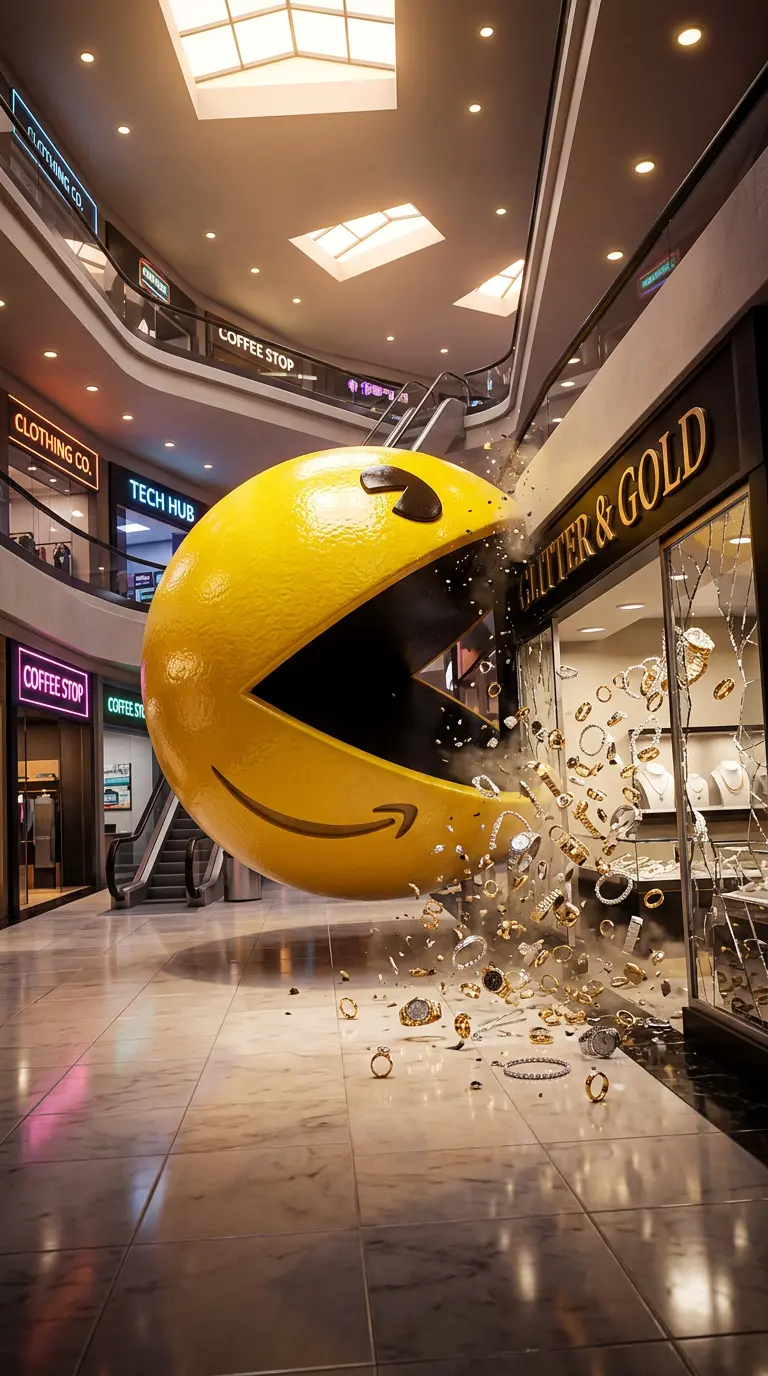
Amazon ate mall jewelry like Pac-Man.
Amazon ate mall jewelry. The lower-ticket stuff went online. The higher-ticket pieces came home to local.
That wasn't your strategy. That was Amazon's accident. You still got the lift.
The decision doesn't happen in your store anymore. It happens online, between you and one or two other locals, on someone's phone. By the time they walk in, the shortlist is already cut.
They're not browsing. They're confirming.
Mother's Day weekend shows it. The person at your case decided last Tuesday from her couch. She walked in because you made the cut.
Watch your foot traffic this weekend. Most of them walked in ready. That's the audition you already won online.
The lower-ticket stuff went online. The higher-ticket pieces came home to local.
That wasn't your strategy. That was Amazon's accident.
You still got the lift.
But the second shift is the one that matters.
The decision doesn't happen in your store anymore. It happens online, on someone's phone, between you and one or two other local jewelers.
By the time anyone walks in, the shortlist is already cut.
They're not browsing. They're confirming.
The person at your case decided before leaving the couch. They walked in because you made the cut.
So the split market hands you the customer Amazon can't serve, then quietly asks a harder question.
How many of your walk-ins arrived already decided? And what did your website do to earn them?
Frequently Asked Questions
What is the Amazon effect on the jewelry industry?
It is what happens to a retail category once buying online becomes effortless.
Anything a customer can evaluate from a photo and a price migrates to the screen.
Fashion jewelry, chains, studs, the gift tier: all went online.
Notice what did not migrate.
Nobody proposes with a ring they one-clicked between a phone case and a water filter.
The considered purchase still wants a counter, a conversation, and a person accountable if something goes wrong.
Is the jewelry industry dying?
No. It is splitting.
Commodity purchases are consolidating online.
Considered purchases, the engagement rings and heirloom pieces, keep closing in person.
The format under real pressure is the mid-tier mall chain. It lived in the middle that is emptying out.
Stores built on trust can win share as the middle empties, if their online presence earns the visit.
Why are mall jewelry chains vanishing while independent jewelers hang on?
Mall chains were built for the exact segment the internet absorbed.
Standardized inventory. Rotating staff. A lease that only works when the mall pulls traffic.
All of it depended on the mid-tier buyer who walked by and wandered in.
That buyer now does the wandering on a phone.
Independents are anchored to the considered purchase, which stayed in person.
But surviving the shakeout is not winning it.
Independents held 35% of the market in 2025, down from 42% in 2020.
Source: Picup Media, The State of Jewelry Ecommerce in 2026 (https://blog.picupmedia.com/the-state-of-jewelry-ecommerce-in-2026-what-the-numbers-tell-operators/)
The sale happens in my store. Does the website really matter?
Yes. The website now decides which store gets the visit.
In person is where the sale closes.
It is no longer where the decision starts.
The buyer compares you against two or three other local jewelers from a couch.
Your website is their first showroom visit.
Four flat photos and a Contact Us form do not lose the sale at the counter.
They lose it before you knew it existed.
My merchandise does not sell without me. Why would a website change that?
It would not replace you. Its job is to deliver you the meeting.
Your salesmanship closes considered purchases.
But it only works on the people who walk in.
The pre-visit comparison happens on a phone, without you in the room.
If your site fails that comparison, your skills never get their chance.
If they walk in, I can close them. Isn't the store what really counts?
The close is real.
But the decision to buy from you often happens before they step inside.
The split market does not reward the store with the best showroom.
It rewards the store that wins the pre-visit decision and then confirms it in person.
A buyer who walks in already leaning toward you is a different conversation than one still deciding among three stores.
What should an independent jeweler do first to prepare?
Audit your store the way a buyer does.
Search your own store.
Open your website on a phone.
Ask whether a stranger could get confident enough there to choose you over the two other local stores they are comparing.
Then fix the weakest step first.
Product pages a buyer cannot decide from.
Unanswered reviews.
A social feed that has gone quiet.
Where do 3D and virtual try-on fit into this?
They move the confidence work online, where the decision now starts.
Browser-based 3D and virtual try-on let a buyer examine a piece the way they would at your counter.
Turning it. Zooming into the setting. Seeing it on their own hand.
Buyers who zoom in tend to stay and play with the piece.
That engagement is the confidence being built.
It is a mechanism, not the strategy.
The strategy is owning the pre-visit confidence work by whatever means fits your store.
The OHZONE Perspective
Jewelry buyers are not price shopping. They are confidence shopping. Stores do not lose sales to price. They lose them when buyers build confidence somewhere else first.
The lower-ticket items went online, and the higher-ticket pieces came home to local stores. That shift should be showing up in your traffic. If you are not seeing an uptick, something in your buyer's journey is not working, and it is usually not the market.
The website is becoming less address lookup and more first showroom visit. The store visit is not the decision. It is the confirmation. In a split market, the store that removes uncertainty fastest wins.
The stores that win the split market will not be the ones with the biggest showroom or the deepest inventory. They will be the ones that remove uncertainty fastest, building confidence before the customer ever gets off the couch.
We do not sell better visuals. We sell confidence before the store visit.
Is Your Website Worth Getting Off the Couch For?
Be your own buyer for three honest minutes.
Open your website on a phone, the way a buyer does.
Ask a buyer's questions.
Could a stranger get confident here?
When did you last update the site?
How many website visitors actually book an appointment with you in a month?
If you are not sure what those three minutes are telling you, we would be happy to walk your customer journey with you and show you where confidence is being built and where it is leaking.
No pitch. Just the walkthrough.
